
Europe Herbal Tea Market Size
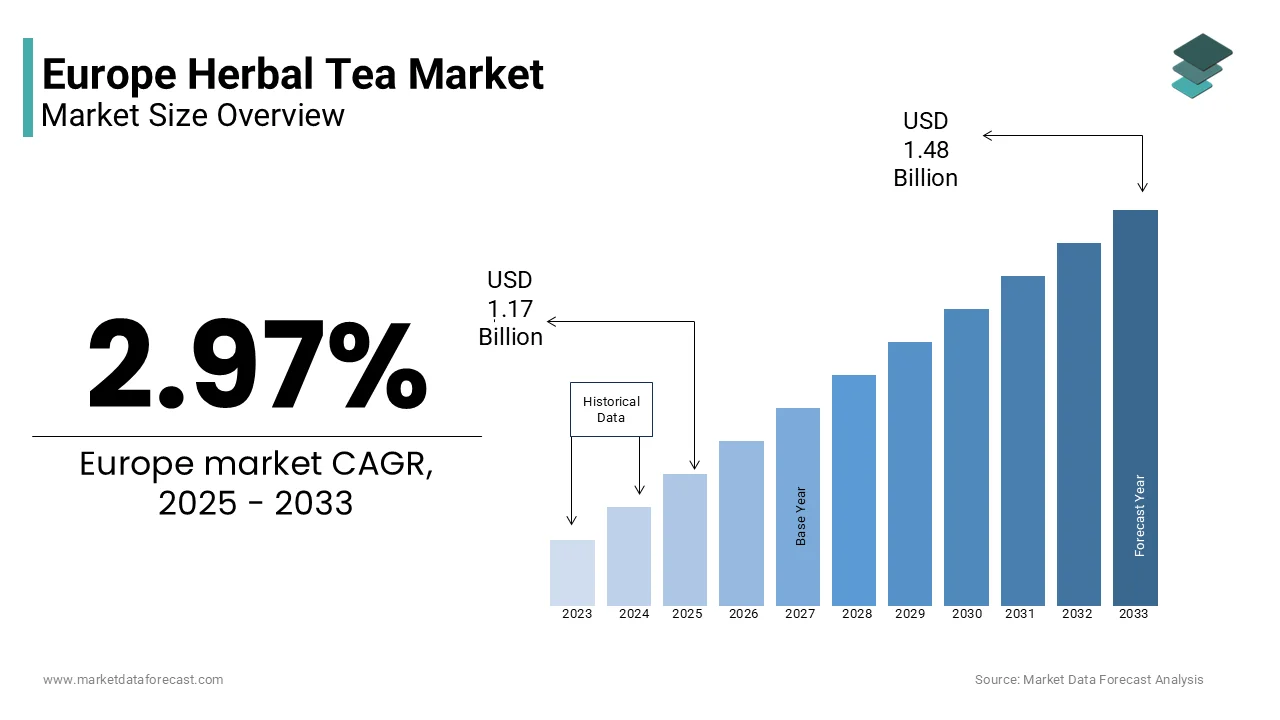
The Europe herbal tea market size was valued at USD 1.19 billion in 2025, and the market size is expected to reach USD 1.55 billion by 2034 from USD 1.23 billion in 2026. The market is growing at a CAGR of 2.97% during the forecast period.
Herbal tea is an infusion made from plants other than Camellia sinensis made by boiling or steeping herbs. Herbal teas are typically made with flower tisanes such as chamomile, lavender, hibiscus, and rose. Herbal teas can also be made with leaf tisanes such as mint, lemongrass, French verbena, and lemon balm. Root tisanes, fruit tisanes, and seed or spice tisanes are also used to blend herbal tea. Unlike coffee and true teas (both of which are available decaffeinated), most tisanes do not naturally contain caffeine.
MARKET DRIVERS
The growing consumer preference for safe, chemical-free, and healthy consumables is one of the major factors driving the market growth. Herbal tea farming is also based on ecological processes, biodiversity, and cycles tailored to local conditions, which keep the soil rich and fertile and promotes plant biodiversity. Furthermore, the growing demand for tea consumption in European countries drives the expansion of the European herbal tea market. The consumption of herbal tea among consumers has increased as there are numerous health benefits associated with the consumption of herbal tea. The increase in awareness among people relating to these health issues is driving the growth of the European herbal tea market.Other factors expected to drive Europe’s herbal tea market growth during the forecast period include an increasing working population, rising demand for ready-to-use products, and expanding retail markets. In addition, herbal tea’s growing popularity as a natural ingredient in personal care products is expected to fuel the demand of the Europe herbal tea market.
MARKET RESTRAINTS
In the forecast period, the high cost of the product and labor exploitation on plantations will most likely act as restraints for the growth of the Europe herbal tea market. The ease of access to product substitutes, combined with a lack of awareness in developing economies, will somewhat limit the market growth. Furthermore, factors such as the prevalence of allergic reactions and various other health consequences are associated with consuming herbal teas. Furthermore, potentially toxic chemicals, such as flavor enhancers, dyes, and adhesives, during the growth or manufacturing of herbs causes harmful health complications.
REPORT COVERAGE
|
REPORT METRIC |
DETAILS |
|
Market Size Available |
2025 to 2034 |
|
Base Year |
2025 |
|
Forecast Period |
2026 to 2034 |
|
CAGR |
2.97% |
|
Segments Covered |
By Product Type, Flavour, Distribution Channel, Form, and Region |
|
Various Analyses Covered |
Global, Regional, & Country Level Analysis; Segment-Level Analysis; DROC, PESTLE Analysis; Porter’s Five Forces Analysis; Competitive Landscape; Analyst Overview of Investment Opportunities |
|
Regions Covered |
UK, France, Spain, Germany, Italy, Russia, Sweden, Denmark, Switzerland, Netherlands, Turkey, and the Czech Republic |
|
Market Leaders Profiled |
Unilever, Associated British Foods plc.., Nestle S.A., Tanla Food Limited and Trade ltd, Harney & Sons Fine Teas, Martin Bauer group, Barry’s Tea, Hain Celestial, Tata Consumer Products, Tielka |
SEGMENTAL ANALYSIS
By Product Type Insights
Based on the product types, the Europe Herbal tea market is segmented by black tea and green tea. Green tea is trending in the market, and most customers prefer it. Furthermore, the increase in the health benefits of consuming green tea contributes to adopting green tea, which further leads to the growth of the particular product and market.
By Flavor Insights
On the basis of flavor, the European herbal tea market is segmented by Ginger, Cardamom, Lemongrass, Peppermint, and Others. In this segment, ginger and cardamom flavors are the most commonly used in herbal tea, and this flavor provides health benefits to the herbal tea consumer.
By Form Insights
The Europe Herbal tea market is divided into three categories: liquid, powder, and premix. The powder and premix are expected to grow in the coming year during the forecast period.
By Distribution Channel Insights
Based on the distribution channel, the Europe Herbal Tea Market is segmented by online supermarkets, hypermarkets, specialty stores, cafes, and restaurants. The cafe and restaurant hold the largest market share in iced tea, where most people prefer to consume iced tea in the cafe. However, the supermarket channel also holds a strong position in the market as a number of people directly purchase the products and prepare them in-house.
REGIONAL ANALYSIS
The UK is the largest tea consumer and holds the market’s largest shares during the forecast period. According to secondary source data, following the UK, Germany is expected to be the largest herbal tea market consumer due to lifestyle changes. Germany consumed 41,081 metric tonnes of herbal and fruit infusions (67.8% by volume) and 19,523 metric tonnes of black and green tea (32.2%), an increase of 1,400 metric tonnes over the previous year. India is Germany’s most important tea trading partner, sending over 7 million kilos in 2023, followed by China and Sri Lanka.
KEY MARKET PLAYERS
Unilever, Associated British Foods plc.., Nestle S.A., Tanla Food Limited and Trade ltd, Harney & Sons Fine Teas, Martin Bauer group, Barry’s Tea, Hain Celestial, Tata Consumer Products, Tielka are some of the notable companies in the Europe Herbal Tea market.
RECENT DEVELOPMENTS IN THE MARKET
- Nestle launched “Nesquik Go Vegetal,” a plant-based tea drink, in Europe in 2023. The drink is intended for vegan consumers, according to the company. This strategy will also allow the company’s product portfolio to grow.
- Tata Consumer Products is expanding its wellness portfolio in the packaged beverages category to meet consumer demands. Tata Tea Tulsi Green and Tata Tea Gold Care are two new products. In addition, Tetley Green Tea has been reformulated with added Vitamin C. These new products are made with beneficial ingredients that are known to boost the body’s immunity and overall wellness.
MARKET SEGMENTATION
This research report on the Europe herbal tea market has been segmented and sub-segmented into the following categories.
By Product Type
- Black Tea
- Green Tea
- Yellow Tea
By Flavor
- Ginger
- Lemongrass
- Peppermint
- Others
By Form
By Distribution Channel
- Online
- Supermarkets
- Hypermarkets
- Specialty Stores
- Restaurants
By Country
- Germany,
- Bulgaria,
- France,
- U.K.,
- Italy,
- Spain,
- Turkey,
- Belgium,
- Netherlands,
- Switzerland,
- Sweden,
- Finland
link