Eating breakfast is a surprisingly vital part of health, and many of us love to wash it down with a glass of OJ. Perhaps you’re drinking it because your blood sugar is low, you want vitamin C to boost immunity or you simply like the taste.
While some nutritional facts about orange juice are pretty well-known and straightforward — like the aforementioned considerable vitamin C content — the effects it has on your body aren’t as clear as previously thought, according to a 2025 study. More specifically, what you reap from the drink may depend on your weight.
“According to the study authors, drinking orange juice activated different genes in ‘overweight’ participants than ‘normal weight’ participants, although they never define what they mean by these terms in the study,” said Christine Byrne, a dietitian and the owner of Ruby Oak Nutrition in Raleigh, North Carolina. “If they were using BMI criteria, ‘normal weight’ means anyone with a BMI of 18.5 to 24.9, while ‘overweight’ means anyone with a BMI of 25-29.9.”
(BMI and its younger sibling, the BRI, have since been debunked, but are still widely used. Descriptors like “normal,” “overweight” and “higher” are in quotations for the former reason.)
Back to orange juice and weight. With these findings, does a glass of OJ still fit into your health goals? Let’s find out. HuffPost talked to registered dietitians about this study, how orange juice may affect your body and what the real-life implications are.

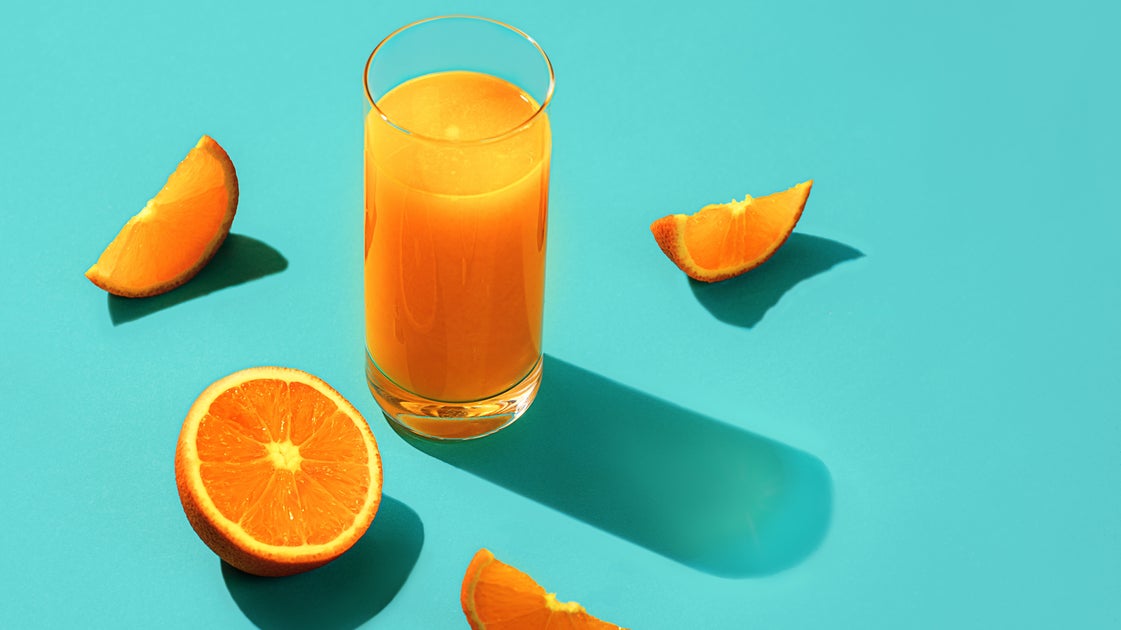
Iryna Veklich via Getty Images
How Orange Juice Affects People With ‘Higher’ Body Weights
In people with “higher” body weights, the study found that orange juice activates genes involved in fat metabolism.
“Vitamin C, in general, helps to boost metabolism by helping convert fat into energy,” explained Kathryn Johnson, a registered dietitian and the nutrition director at Eating Recovery Center. “It also aids in carnitine production, which transports fats to cells for burning.”
How Orange Juice Affects People With ‘Normal’ Body Weights
In people with “normal” body weights, the study found that orange juice affected genes that regulate inflammation, which a 2024 study calls “the cause of all diseases.”
The reasoning comes down to your body’s priorities, or where you most need the nutrients.
“We know that when people are malnourished or undernourished, it can affect things like growth, your menstrual cycle and adequately fighting infection,” Johnson said. “So while vitamin C still provides the stated benefits above, it takes more energy to burn fat than carbohydrates. That is lower on the list of what the body is able to do.”
Higher on the body’s list, she continued, are more medically important things, such as getting oxygen to your cells, pumping the heart and transporting blood.
This isn’t to say that all people with a “normal” or even “lower” body weight are malnourished or undernourished.
Timely side note: The International Diabetes Federation officially recognized Type 5 diabetes as a disease in 2025, and it often affects people who experienced long-term malnourishment, especially in their formative years.
The Real-Life, Everyday Implications Of This Study’s Findings
According to Johnson, the point of the study is this: “Your body functions more effectively when adequately nourished.” In other words, it doesn’t have to worry about carrying out other functions first.
This truth extends beyond orange juice: Johnson added how some medications, minerals and vitamins don’t work as effectively when the consumer is undernourished or malnourished.
But that’s about it. Don’t take information from the study that it’s not giving.
“Frankly, I don’t think there’s any real-life takeaway from a study like this,” Byrne said.
Why? Because the study only had 20 participants, they were in a relatively small age range (21 to 36 years old) and gene expression, not an outcome, was assessed.
“Different genes play a role in different biological processes, but activating certain genes doesn’t guarantee that anything will happen,” Byrne continued. “For example, activating genes involved with fat metabolism doesn’t mean that you’re going to burn more fat.”
She added that the relationship between nutrition and gene expression is something that we’re only beginning to understand. These studies provide an evidence base, but it’s too early to draw an accurate, confirmed conclusion or recommendation.
The Takeaway: Bodies Are Different And Have Different Needs
We would be remiss to ignore that this research conclusion illustrates how bodies are different, have different needs and respond to nutrients differently.
“The idea that different foods affect people differently is a good takeaway from this study — and maybe the only relevant takeaway for most people,” Byrne said.
Other examples of how the same foods can have different effects include:
Along these lines, we can’t assume someone’s health by looking at their body size. That has always been true for many reasons, plus another recent one.
“With increased GLP-1 medications, we are seeing more patients whose BMI may fall into the ‘normal’ category, but due to weight loss [and the] amount of food/protein that they are able to take in, their body is presenting as undernourished,” Johnson said.
Needless to say, bodies and nutrition (and even orange juice) are more complex than previously thought, and research is still ongoing. That diversity is a beautiful, important thing we can’t ignore.
link